

Table of Contents
- The Real Drivers Behind Sustainable Activewear Prices
- Sustainable Activewear Materials Guide: What You Pay For
- The Benefits of Sustainable Activewear That Justify the Price
- How Women Owned Activewear Brands Price Their Gear
- Chemical Safety and Toxicity: What Cheap Gear Hides
- How to Test Fabric Quality Before You Buy
- Conclusion: What Your Purchase Actually Supports
- Frequently Asked Questions
Last Updated: September 23, 2026
The Real Drivers Behind Sustainable Activewear Prices
Sustainable activewear costs more because the price reflects expenses that conventional gear hides: certified raw materials, traceable supply chains, and wages that let workers live on what they earn. The gap is not marketing. It is the cost of doing the unglamorous work correctly, from fiber to finished seam.
Most shoppers assume the premium is branding. It is not.
Certified Materials and Traceable Supply Chains
Certification costs money before a single garment exists. A mill that wants organic or recycled fiber certification pays for audits, chain-of-custody documentation, and periodic re-inspection. Those costs travel down the supply chain and land on the label.
Traceability adds another layer.
Ethical Labor and Living Wages
Paying a living wage changes the math on every unit. A factory that pays workers enough to cover housing, food, and healthcare in their region charges more per garment than one paying minimum piece rates. Brands that commit to this absorb the difference or pass it on.
Sustainable Activewear Materials Guide: What You Pay For
A sustainable activewear materials guide starts with the fibers themselves. Recycled polyester, organic cotton, merino wool, and lyocell each carry a premium because producing them responsibly costs more than the conventional alternative, but the premium is not uniform, and it does not map cleanly to performance. Two fibers can cost the same per yard and behave completely differently after 50 washes.
| Material | Key Property | Cost Driver | Best For |
|---|---|---|---|
| Recycled polyester (rPET) | Moisture-wicking, durable | Collection, sorting, and re-polymerization of post-consumer bottles; feedstock must be cleaned to food-grade before spinning | High-sweat training |
| Merino wool | Thermal regulation, odor-resistant | Animal welfare standards, slow growth cycle (one fleece per year per animal), and fine-micron sorting | Cool-weather layers |
| Organic cotton | Breathability, soft hand | No synthetic pesticides, third-party farm audits, and lower yields per acre than conventional cotton | Low-impact movement |
| Lyocell | Hydrophilic, smooth drape | Closed-loop solvent recovery, the solvent is captured and reused, which requires capital-intensive equipment | Everyday wear |
| Recycled nylon | Abrasion resistance, elasticity | Regenerated feedstock from fishing nets and carpet; energy-intensive re-melting | Compression gear |
| Spandex (elastane) | Four-way stretch, shape retention | Petroleum-derived; cannot currently be recycled at scale, so it caps a garment's end-of-life options | Any stretch garment |
Why Blends Cost More Than the Sum of Their Parts
Blends matter more than most shoppers realize. A 80/20 polyester-spandex blend delivers four-way stretch and shape retention, but the spandex content is what makes the garment hard to recycle, most municipal textile programs cannot separate elastane from polyester. Merino blended with nylon improves durability without losing breathability, but the two fibers require different dye baths, which adds a processing step and a cost line.
The Weight and Denier Question
Fabric weight is measured in grams per square meter (GSM). A lightweight yoga legging often sits in the 200-240 GSM range, while a high-impact training tight is typically 240-300 GSM. Heavier fabric generally means better opacity and abrasion resistance, but it also means more fiber per garment, so a 300 GSM tight costs more to make than a 220 GSM tight even if the fiber is identical.
What the Certification Actually Covers
A certification label is not a performance guarantee. GOTS covers the organic status of the fiber and the social and environmental criteria of processing, but it does not test for performance. OEKO-TEX STANDARD 100 tests for harmful substances in the finished textile (OEKO-TEX® STANDARD 100). bluesign focuses on input chemistry and resource use at the mill level. A garment can carry one, two, or all three, and each one adds a separate audit cost that lands on the price.
OEKO-TEX STANDARD 100 explained
The Benefits of Sustainable Activewear That Justify the Price
The benefits of sustainable activewear show up in how the gear performs and how long it lasts, not just in how it is made. But "it lasts longer" is the answer every brand gives. The more useful question is: what specifically degrades in cheap gear, and what does that degradation cost you over time?
The Lifecycle of a Cheap Garment
Most mass-market activewear fails in a predictable sequence. First, the spandex loses recovery, usually within 30 to 50 wash cycles, and the garment stops snapping back. Second, the surface pills as short fibers work loose from the knit. Third, the seams start to abrade where the fabric rubs against itself. By the time the fourth failure (color fading) shows up, the garment has already been retired.
Cost Per Wear, Not Sticker Price
Cost per wear is the only honest way to compare a $90 sustainable legging to a $25 fast-fashion pair. If the cheap pair survives one season of twice-weekly training, roughly 100 wears, it costs about $0.25 per wear. If the sustainable pair survives two years of the same schedule, roughly 200 wears, it costs about $0.45 per wear. The sustainable pair is still more expensive per wear, but the gap is far smaller than the sticker price suggests, and the sustainable pair is still in rotation when the cheap pair is in a landfill.
Identifying End of Life
Knowing when to retire a garment is part of getting value from it. A common pattern is that people keep wearing gear past the point where it performs, which means they are training in fabric that no longer wicks, no longer holds shape, and no longer protects against chafing.
Use these signals to call it:
- Recovery failure: The fabric stays stretched after you take it off. If a waistband does not snap back within a few seconds, the spandex is spent.
- Opacity loss: Hold the fabric up to a light. If you can see through it in a way you could not when it was new, the knit has thinned.
- Pilling clusters: Isolated pills are cosmetic. Clusters across high-friction zones (inner thigh, underarm) mean the yarn structure is breaking down.
- Seam abrasion: If flatlock seams feel rough or show frayed thread, the stitching is failing before the fabric.
- Persistent odor: If a garment smells after a normal wash, the antimicrobial finish has worn off or bacteria have colonized the fiber. Either way, it is done.
What You Are Actually Buying
When you pay a premium, you are buying a longer window of peak performance, not a permanent garment. The benefit is that the window is predictable and testable, which means you can decide for yourself whether the premium is worth it for how you train.
How Women Owned Activewear Brands Price Their Gear
Women owned activewear brands often price differently because they build smaller runs and control more of the process. Limited production means higher per-unit costs, but it also means less waste and tighter quality control.
Chemical Safety and Toxicity: What Cheap Gear Hides
Cheap gear often hides its chemical story. Conventional dyes, finishes, and treatments can leave residues that budget manufacturing does not bother to remove.
How to Test Fabric Quality Before You Buy
You can judge fabric quality before you buy by checking stretch, recovery, and construction. A few seconds of handling tells you more than any label claim.
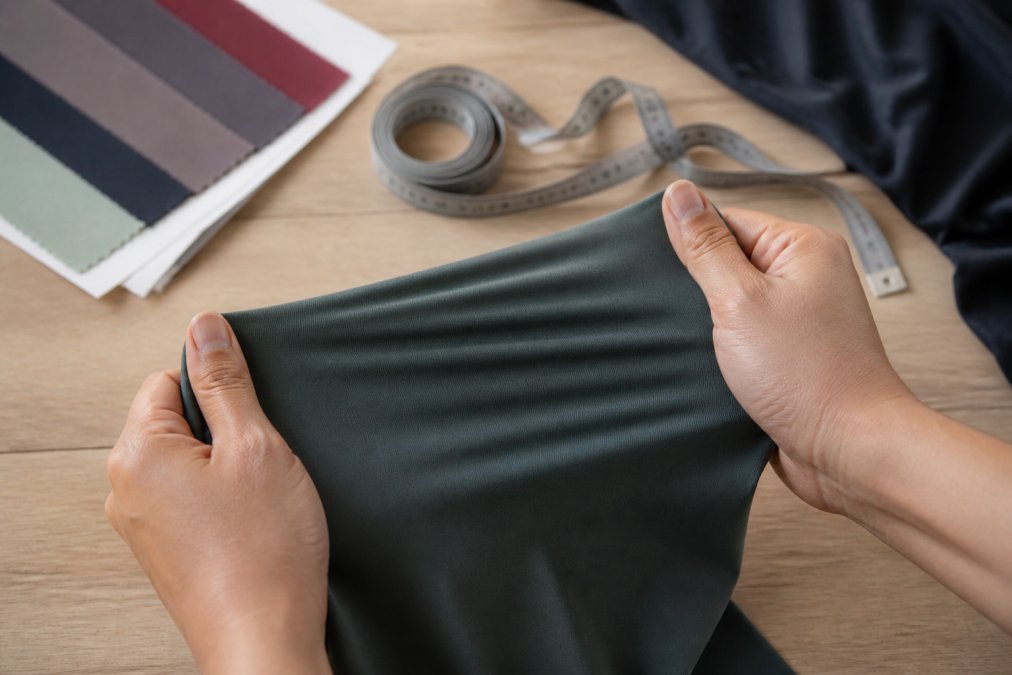
Use this checklist:
- Stretch the fabric in both directions. Four-way stretch should move freely and snap back.
- Check the seams. Flatlock stitching resists chafing better than bulky overlock seams.
- Look for pilling. Rub the surface; loose fibers signal early wear.
- Read the certification. OEKO-TEX or bluesign labels confirm chemical testing.
- Feel the weight. Heavier fabric often means better durability and opacity.
- Test recovery. Squeeze and release; slow return means poor shape retention.
Conclusion: What Your Purchase Actually Supports
Every purchase is a vote for how gear gets made. Choosing sustainable activewear means funding traceable supply chains, living wages, and fabrics tested for safety, not just a logo.
Frequently Asked Questions
Why is sustainable activewear more expensive than fast fashion?
Sustainable activewear costs more because brands pay for certified materials like recycled polyester and organic cotton, fair wages for workers, and third-party certifications that verify environmental claims. Fast fashion cuts costs through synthetic fabrics, overseas labor without wage standards, and short production cycles. The price difference reflects what goes into making the garment, not just the brand name on the tag.
Does sustainable activewear last longer than traditional synthetic gear?
Often, yes. Higher-quality sustainable activewear uses denser knit construction, flatlock stitching, and better spandex blends that resist pilling and hold shape through repeated washing. Cheaper synthetic gear tends to lose elasticity and develop odor faster because it uses lower denier yarns and thinner fabric weights. Longer garment life means fewer replacements, which offsets the higher upfront cost over time.
What materials are used in high-quality sustainable activewear?
Compare the actual fabric, construction and care instructions with your activity needs. OEKO-TEX STANDARD 100 tests certified textiles for harmful substances against its criteria; it does not certify that no chemicals were used during production, or prove durability, fair labor or reduced environmental impact.
How do ethical labor practices affect the price of athletic clothing?
Paying workers a living wage, providing safe conditions, and auditing factories adds cost at every production stage. Brands that skip these steps keep prices low by cutting labor expenses. When you see a $15 leggings price tag, the person who made it likely earned a fraction of that. Ethical production adds to manufacturing costs, which shows up in the retail price.