

Table of Contents
- Ethical Gym Wear for Men: What It Actually Means
- The Difference Between Ethical and Greenwashed
- Sustainable Athletic Apparel: Materials That Hold Up
- Performance Gear for Daily Training: Does Ethical Mean Weaker?
- How to Verify a Brand's Claims Before You Buy
- Enclothed Cognition: How Your Gym Wear Shapes Your Mindset
- Caring for Ethical Gym Wear So It Lasts
- Building a Conscious Wardrobe for the Gym
- Frequently Asked Questions
Last Updated: September 12, 2026
Ethical Gym Wear for Men: What It Actually Means
Ethical gym wear for men is athletic apparel made with verified labor standards, reduced environmental impact, and transparent supply chains, decisions made before the garment reaches you: who made it, what it's made from, and where the profits go.
Most men shopping for training gear in 2026 face the same problem: "sustainable" appears on nearly everything, but almost nothing behind it is verifiable. This guide from Burrow Athletic covers what ethical gym wear means, which materials survive real training, how to spot greenwashing, and why the psychology of what you wear matters.
The stakes are higher than a return label. FTC Green Guides on environmental marketing claims exist precisely because vague environmental language became a widespread problem. Knowing how to read a claim is now a basic shopping skill.
The Difference Between Ethical and Greenwashed
Greenwashing is when a brand markets itself as environmentally or socially responsible without evidence. Ethical production means a company can show where its materials came from, who assembled the garment, and where the revenue goes.
The gap between the two is enormous. A recycled polyester shirt sounds responsible until you learn the factory that sewed it pays below a living wage, and a "carbon-neutral" label means little without third-party verification.
Here's what separates the two in practice:
- Ethical: Named suppliers, published factory lists, third-party certifications, specific donation disclosures
- Greenwashed: Vague phrases like "eco-friendly" or "planet-positive" with no documentation, no named certifications, and no financial transparency
Sustainable Athletic Apparel: Materials That Hold Up
Sustainable athletic apparel for men comes down to two material families: recycled synthetics and natural fibers engineered for movement. Neither is automatically better. What matters is whether the material performs under repeated training and holds its shape after a year of washing.
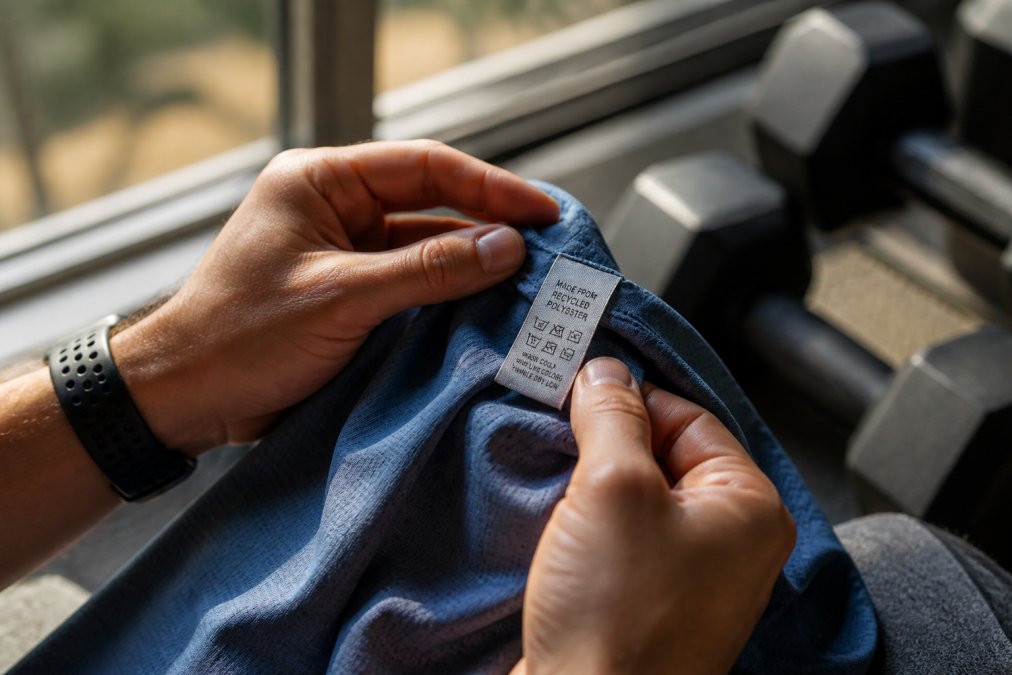
Recycled Polyester vs. Virgin Polyester
Recycled polyester may use recovered plastic, including PET bottles, while virgin polyester uses new feedstock. Performance depends on yarns, fabric construction and finishing; recycled content alone does not establish drying speed, durability or lower overall environmental impact.
The practical difference is resource use: recycled polyester diverts plastic waste from landfills and requires less energy to produce.
What most guides miss: recycled polyester still sheds microplastics in the wash. If that concerns you, a wash bag designed to capture fibers is a cheap fix that makes a real difference.
Natural Fibers That Work for Training
Merino wool regulates temperature and resists odor naturally, meaning fewer washes and a longer lifecycle. Tencel lyocell, made from wood pulp in a closed-loop process, feels cool against skin. Organic cotton works for warm-up layers and rest days, though it holds sweat and dries slowly.
The honest limitation: no natural fiber matches synthetic wicking for high-sweat sessions. Use them for the right job.
Performance Gear for Daily Training: Does Ethical Mean Weaker?
No. The assumption that values-driven gear sacrifices function is outdated: performance depends on fabric engineering, seam construction, and fit, not supply chain ethics.
A well-made recycled polyester blend with flatlock seams and a gusseted crotch will outperform a poorly constructed virgin polyester shirt every time. The variables that matter:
| Factor | What to Look For | Why It Matters |
|---|---|---|
| Fabric weight | 150-180 gsm for training | Balances breathability and durability |
| Seam type | Flatlock or bonded | Prevents chafing under load |
| Stretch | 4-way mechanical or elastane blend | Full range of motion |
| Wash durability | 50+ cycles without pilling | Determines real cost per wear |
How to Verify a Brand's Claims Before You Buy
Verification separates a real ethical purchase from a marketing exercise. A serious check takes about ten minutes, mostly reading.
The goal isn't to become an auditor, it's a fast filter for whether a brand shows evidence or asks you to trust a feeling.
The Three Tiers of Proof
Rank what you find in three tiers:
Tier 1, Independent third-party certification. A named certifying body with public standards, an audit process, and a searchable database. The strongest signal, because the brand doesn't control the outcome.
Tier 2, Self-published transparency. Factory lists, supplier names, wage policies, annual impact reports. Strong when specific and consistent year over year; weak when it's a single undated PDF.
Tier 3, Marketing language. "Eco-friendly," "planet-positive," "consciously made," "sustainable by design." These phrases have no defined legal meaning in most contexts and prove nothing.
If a brand's entire ethical story lives in Tier 3, you have your answer.
A Verification Checklist You Can Run in Ten Minutes
Work through this before you spend:
- Does the brand publish a factory or supplier list with named facilities?
- Is there a named third-party certification, and can you find that certifier's own website and search the brand in its database?
- Does the brand state a specific donation amount or percentage, not just "a portion of proceeds"?
- Can you find the foundation or charity it supports as a registered entity with its own public presence and annual reporting?
- Are there independent reviews from customers who trained in the gear for months, not days?
- Does the brand's language stay specific when it talks about impact, or does it drift into vague, feel-good phrasing?
Search the brand's name alongside the word "certification" and the name of the charity it claims to support. If the charity is real, it will have its own public presence and annual reporting. If you can't find it independently, that's your answer.
How to Read a Certification Without Getting Fooled
A certification is only as strong as the body behind it. Two questions cut through the noise:
- Who audits, and how often? Self-reporting is weaker than periodic third-party site visits.
- Is the brand listed in the certifier's public database? If it claims a certification but doesn't appear in the certifier's directory, investigate.
A common pattern is a brand displaying a certification logo that belongs to a supplier, not the brand itself. The supplier may genuinely be certified. That doesn't mean the finished garment was made under those conditions end to end. Ask which entity holds the certification.
The Greenwashing Patterns to Watch For
Most greenwashing isn't a lie, it's a selective truth. The patterns that show up again and again:
- The borrowed badge. A certification logo that applies to one material or one supplier, presented as if it covers the whole product.
- The offset claim. "Carbon-neutral" language with no named offset provider, no verification standard, and no published tonnage.
- The vague donation. "We give back" with no percentage, no recipient, and no reporting.
- The nature logo. A leaf, a mountain, or an earth-tone palette doing the work that documentation should be doing.
- The moving target. Impact numbers published once, never updated, never audited.
The most common greenwashing trap is a nature-themed logo paired with zero certification. If a brand can't name its certifying body or show a factory list, treat the claim as decoration. You'll pay a premium for nothing verifiable.
What to Do When the Evidence Is Mixed
Most brands land somewhere in the middle: a factory list but no wage policy, one real certification on a single product line, a legitimate charity but silence on supply chain details.
That's not automatically disqualifying. What matters is whether the brand is moving toward more transparency or using partial transparency as cover, look for disclosures getting more specific over time and claims that stay consistent rather than shifting with marketing cycles.
If you can't tell after ten minutes, the honest move is to buy from a brand where you can.
Enclothed Cognition: How Your Gym Wear Shapes Your Mindset
Enclothed cognition is the psychological principle that what you wear influences how you think, feel, and perform. The term was coined by researchers Hajo Adam and Adam Galinsky, whose work showed that clothing carries symbolic meaning and that wearing a garment activates the mental state associated with it. In their best-known experiments, participants told a white lab coat was a doctor's coat showed sharper attention than those told it belonged to a painter. Same fabric, different meaning, different cognitive result.
Most ethical apparel content stops at the supply chain, who made it, what it's made from, where the money goes. All of that matters, but it misses the second half of the equation: what the garment does to the person wearing it.
Why the Effect Is Real and Not Just Marketing
Enclothed cognition works through two conditions present at the same time:
- The garment has to carry symbolic meaning. A plain gray tee means nothing on its own; a shirt you associate with hard sessions, discipline, and showing up carries weight.
- You have to actually be wearing it. The effect doesn't fire when the shirt is in your bag, only when it's on your body and you're aware of what it represents.
That second condition is why the ritual of changing into training gear matters. You're not just getting dressed; you're switching states.
What This Looks Like in a Real Training Week
Many men who train consistently build a small set of "signal" garments, pieces reserved for training and nothing else. The association stays clean, and putting them on becomes a reliable cue.
You can use this deliberately:
- Reserve one or two pieces for hard sessions only. Keep them separate from casual laundry so the association doesn't dilute.
- Dress for the session you want, not the one you're in. If you're dragging, put on the gear you associate with your best training days. The cue often does more than motivation alone.
- Let fit do part of the work. A garment that fits well and moves with you removes friction. A garment that rides up, chafes, or bunches adds a low-grade distraction that pulls attention away from the session.
The Ethical Layer Most Guides Skip
Here's where ethical gym wear and enclothed cognition intersect. When you know who made your gear, what it's made from, and where the profits go, the garment's symbolic meaning changes. It stops being just "my training shirt" and becomes "my training shirt that I chose on purpose."
That shift is small but it compounds: over a training year, the shirt you feel good about wearing is the one you reach for and the one that earns its place instead of getting replaced every few months.
Enclothed cognition is not a reason to buy more gear. It's a reason to buy fewer, better pieces and assign them clear meaning. A small, intentional training wardrobe outperforms a crowded one, both psychologically and environmentally.
The Honest Limits
The research on enclothed cognition is real but it isn't magic. It won't replace sleep, programming, or consistency, it removes friction and adds a small, repeatable nudge. Treat it as one input among many, not a shortcut.
Be skeptical of brands that lean on the concept as a sales pitch. "This shirt will make you train harder" is a claim no garment can honestly make. A garment can only carry the meaning you assign to it, and that meaning is yours to set.
Caring for Ethical Gym Wear So It Lasts
Extending a garment's life is the highest-impact thing you can do for its environmental footprint: the longer you wear it, the lower its impact per use.
Follow the garment’s care label for washing and drying. Avoid fabric softener when the instructions prohibit it, and check whether air drying is recommended. Wash when needed for hygiene; odor resistance does not make worn clothing clean.
A common mistake is treating gym wear like everyday laundry. The care routine determines whether a shirt lasts one season or three.
Building a Conscious Wardrobe for the Gym
A conscious wardrobe for the gym is a small, versatile set of pieces you actually wear, chosen for durability and values alignment rather than volume. Five to seven items cover nearly every training scenario.
Start with two or three wicking training shirts, one or two pairs of shorts or joggers with four-way stretch, and a warm-up layer. Choose neutral colors so everything pairs, and replace items only when they fail, not when a new drop appears.
Burrow Athletic is rooted in character, resilience, and purpose. Every purchase supports The Be Good Foundation. Burrow Athletic’s current product range focuses on headwear, including GOAT.
Frequently Asked Questions
What makes gym wear considered 'ethical'?
Ethical gym wear meets three standards: materials sourced responsibly (recycled fibers or organic cotton), manufacturing that treats workers fairly, and transparency about where and how the product was made. Brands that support social causes through donations add another layer. The key is verifiable action, not just marketing language. Look for published supply chain details, third-party certifications, and specific claims about environmental impact rather than vague statements about being 'green' or 'sustainable.'
Are there sustainable alternatives to polyester gym clothes?
Yes. Recycled polyester made from plastic bottles performs nearly identically to virgin polyester, with the same moisture-wicking and durability properties. Tencel (lyocell) offers breathability and softness for lower-intensity training. Organic cotton works for warm-up layers and casual gym wear but holds sweat and dries slowly. Bamboo blends provide odor resistance. For high-sweat sessions, recycled polyester remains the most practical sustainable choice because it matches the performance you already expect from traditional gear.
Does ethical gym wear perform as well as traditional brands?
When the fabric specs match, performance matches. A recycled polyester training shirt with the same weight and weave as a conventional one will wick sweat, resist odor, and hold shape through the same number of washes. The difference shows up in construction quality, not ethics. Check stitching at stress points, flatlock seams, and whether the fabric has four-way stretch if you need mobility. Ethical brands that cut corners on construction will disappoint regardless of their mission.
How do I know a brand's donation claims are real?
Look for a named foundation or nonprofit partner, a stated donation model (percentage of profits, flat amount per item, or round-up at checkout), and any public reporting on funds given. Brands that name the organization and explain the mechanism are more accountable than those saying 'a portion of proceeds.' You can also check whether the foundation has its own public presence and whether the brand shares impact updates. If the details are vague, ask directly before buying.