

Last Updated: November 5, 2026
Quick Summary
Rate of force development (RFD) is how quickly your muscles ramp up force after a squat movement starts. You improve it by building a strength base, adding fast compensatory acceleration sets at 40 to 60 percent of your max, layering in plyometric jumps, and tracking bar speed over time.
- Build a strength base with 3 to 6 rep squats 2 to 3 times per week before chasing speed.
- Use compensatory acceleration at 40 to 60 percent of your max squat, doing 3 to 5 sets of 3 to 5 reps.
- Rest 2 to 3 minutes between fast sets so every rep stays quick.
- Add plyometric squat variations like pause squat jumps and box jumps, starting with 2 to 4 sets of 3 to 5 reps.
- Track bar speed and load each week to see whether your RFD is improving.
Table of Contents
- What Rate of Force Development Means for Your Squat
- What You'll Need Before Starting
- Step 1: Build a Strength Base Before Chasing Speed
- Step 2: Add Compensatory Acceleration Training to Your Sets
- Step 3: Layer in Plyometric Squat Variations
- Step 4: Track Bar Speed With Velocity Based Training for Squats
- Common Mistakes That Slow RFD Gains and How to Avoid Them
- Putting It Together: Your Next Training Block
- Frequently Asked Questions
What Rate of Force Development Means for Your Squat
Rate of force development, often shortened to RFD, is how quickly your muscles can produce force after you start a movement. It matters most when you need to stand up fast out of the bottom of a squat. Two lifters can reach the same max weight, but the one with stronger RFD gets the bar moving sooner and with more punch.
Rate of force development is a training quality you build on purpose, not something that comes free with heavier lifts.
Here is the practical difference:
- Max strength is how much weight you can move once.
- Rate of force development is how fast you can ramp up force, especially in the first moments of a lift.
- Power combines force and speed, so improving RFD often improves power.
Most lifters notice the gap first in the sticking point, the moment a squat feels stuck just out of the hole. Better RFD helps you drive through that point instead of grinding it out.
What You'll Need Before Starting
You do not need a special setup to train RFD in squats, but a few basics make the work safer and easier to track:
- A squat rack with safety pins set at a height you can control
- A barbell and plates you can load in small jumps
- A bench or box for box squats or pause squats
- A sturdy pair of training shoes with a flat, stable sole
- A timer or stopwatch, or a bar speed device if you have one
- A notebook or app to log sets, reps, loads and how the reps felt
Warm up with 5 to 10 minutes of easy cardio and two or three light squat sets. Save your fastest reps for when you feel fresh. Fatigue slows force production, so rushing into speed work on a tired body defeats the point.
Step 1: Build a Strength Base Before Chasing Speed
Strength comes first. Lifters who try explosive work without a solid base often see little gain and more risk. A stronger muscle has more force to express quickly.
Start with a simple plan:
- Squat 2 to 3 times per week.
- Work in the 3 to 6 rep range for main sets.
- Use loads you can move with good form for every rep.
- Add weight slowly over several weeks.
Focus on controlled, deliberate reps at this stage. Do not rush the descent. Once your main lifts feel steady and you can handle heavier loads with clean form, you have a base to build speed on. Plan about 4 to 8 weeks here before moving to the next step, depending on how long you have trained. Read the impact of fitness on mental health to see how consistent training supports motivation over time.
Step 2: Add Compensatory Acceleration Training to Your Sets
Compensatory acceleration training (CAT) means you try to move the bar as fast as possible on every rep of a submaximal load. Even if the bar moves slowly, your intent stays on speed. This trains your nervous system to recruit muscle fibers quickly.
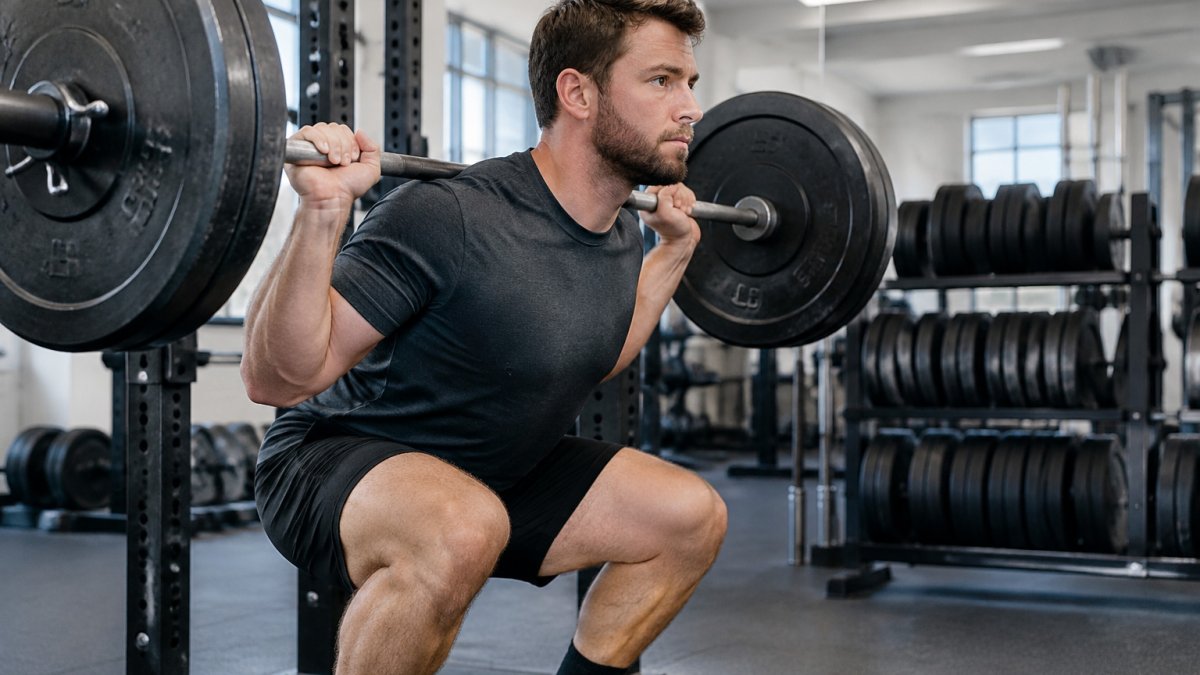
How to apply it:
- Pick a load around 40 to 60 percent of your max squat.
- Do 3 to 5 sets of 3 to 5 reps.
- Pause briefly at the bottom, then drive up as explosively as you can.
- Rest 2 to 3 minutes between sets so each rep stays fast.
Stop a set when your bar speed drops noticeably. Speed work done while tired trains slowness, not power. Keep the loads light enough that every rep looks and feels fast to you.
!Lifter in a gym squatting with a loaded barbell across the upper back, mid-descent, focused expression, weight plate rack and bright overhead lighting in the background
Step 3: Layer in Plyometric Squat Variations
Plyometric squat variations add a stretch-shortening cycle, which is the quick loading and release of muscle and tendon (CURRENT CONCEPTS OF PLYOMETRIC EXERCISE). This is one of the most direct ways to train fast force production because it teaches your nervous system to switch from absorbing force to producing it in a fraction of a second.
Good options, in order of difficulty:
- Squat jumps with a pause, start in a quarter squat, pause for one second, then jump straight up. This removes the bounce and builds pure concentric power.
- Bodyweight jump squats, perform a continuous set of jumps, landing softly and resetting your stance each rep.
- Loaded jump squats, hold a light dumbbell or wear a weighted vest at 10 to 20 percent of your body weight. Keep the load light enough that jump height does not drop noticeably.
- Box jumps, step up onto a sturdy platform and land softly. Step down between reps rather than jumping down to reduce eccentric stress on the knees and Achilles.
Start with 2 to 4 sets of 3 to 5 reps and keep at least 48 hours between heavy lower body days. A common pattern is to pair plyometrics with a strength day as a finisher or to place them on a separate speed day before any grinding work. Land softly with knees tracking over toes and hips back. If your knees cave in, your landings sound loud, or your jump height drops across sets, reduce the height or volume. Optimizing your pre-workout timing ensures that your nervous system remains primed for these explosive efforts rather than struggling through a depleted session.
Watch out: Plyometrics are demanding on the joints and tendons. Build into them slowly, and stop if you feel sharp or unusual pain. Do not add plyometrics on top of a high-volume strength block without reducing squat volume first, because the combined stress can slow recovery and blunt the speed gains you are trying to build.
After a plyometric session, change out of damp training gear promptly. Moisture trapped against the skin during cool-down can leave performance fabrics heavy and slow to dry, and repeated exposure to sweat and friction at the knees and hips is a common reason athletic apparel wears out at high-stress seams. A spare pair of shorts or a fresh base layer in your bag makes the post-session routine easier, and it keeps your training gear ready for the next speed day.
Step 4: Track Bar Speed With Velocity Based Training for Squats
Velocity based training (VBT) uses bar speed to guide your loads and fatigue. Instead of guessing, you measure how fast the bar moves and adjust training to match.
Two simple ways to use it:
- With a bar speed device: Set a target speed for each load. For many lifters, moving the bar at a fast speed on warm-up sets signals a good day to push. A slowdown across sets suggests you should end the session.
- Without a device: Use a phone video in slow motion to estimate speed, or simply rate each rep's speed on a 1 to 10 scale and log it.
Track speed alongside load and reps. Over time, you will see which loads keep your bar speed high, which tells you when your RFD is improving.
Common Mistakes That Slow RFD Gains and How to Avoid Them
Most RFD stalls come from a few predictable habits:
- Training fast only when tired. Do speed sets early in the session, after warm-up and before heavy grinding work.
- Using loads that are too heavy. If the bar moves slowly, you are building strength, not speed. Lighten the load.
- Skipping rest. Short rest brings fatigue into every rep. Give yourself 2 to 3 minutes between fast sets.
- Doing too much plyometric volume. More jumps do not mean more power. Keep volume low and quality high.
- Ignoring sleep and recovery. Poor recovery limits how hard you can push, which caps RFD progress. Aim for consistent sleep and easy days between hard sessions.
- Failing to track. Without logs, it is hard to tell whether you are improving. Record speed and load each week.
A common mistake is adding too many new exercises at once. Change one variable at a time so you can see what is working. Read about compression gear for muscle recovery if fatigue between hard sessions is holding you back. Learn how physical activity improves sleep quality, since good recovery often limits RFD progress.
Putting It Together: Your Next Training Block
Here is a sample 4-week block that combines all four steps. The table shows the main work, but the notes below it explain how to adjust the block and how to care for your training gear so the work holds up week after week.
| Week | Focus | Sample Work | Frequency |
|---|---|---|---|
| 1 to 2 | Strength base | 3 to 6 rep squats, progressive load | 2 to 3 times per week |
| 3 | Speed and CAT | 40 to 60 percent load, 3 to 5 fast sets of 3 to 5 reps | 2 times per week |
| 4 | Plyometrics and VBT | Box jumps and squat jumps, track bar speed each set | 1 to 2 times per week |
Keep your heavy strength day and your speed day separate. Deload with lighter work if your bar speed drops across two sessions in a row. A common pattern is to run the block for four weeks, then take one lighter week before repeating it with slightly heavier loads on the strength days.
Track more than load. Log bar speed, how each set felt on a 1 to 10 scale, and any joint aches that show up after plyometric work. If your speed numbers stall for two weeks while sleep and nutrition are steady, reduce plyometric volume before adding more strength work.
Aftercare matters as much as the sets. Cool down with five minutes of easy walking and a few gentle squat patterns, then change out of damp training clothes before you leave the gym.
Plan your next training block with gear that matches your effort. Visit Burrow Athletic to see the current selection, and learn more about the work of The Be Good Foundation.
Frequently Asked Questions
What is rate of force development (RFD) in weightlifting?
Rate of force development is how quickly you can produce force after a muscle begins to contract. It is measured as force divided by time, usually over the first 0 to 200 milliseconds of a movement. In a squat, higher RFD means you can drive out of the bottom position faster and with more control. Training for RFD focuses on intent to move quickly, lighter loads moved fast, and exercises that reward explosive output rather than only maximal strength.
Why is RFD important for squat performance?
RFD matters most when you need to accelerate a load from a dead stop or from a deep position. Maximal strength tells you how much weight you can eventually lift, while RFD determines how quickly you can apply that force. Lifters with high RFD often look more explosive out of the hole, which helps in sports that demand fast changes of direction and jumping. Improving RFD without first building a base of strength tends to produce limited results.
Can you improve RFD without heavy weights?
Yes. Lighter loads, typically in the range of 30 to 60 percent of your one-rep max, moved with maximal intent can improve how quickly you produce force. Jump squats, box jumps, and bodyweight explosive work also train RFD. Heavier strength work remains useful because it builds the force capacity that RFD draws on, so most lifters combine both approaches rather than choosing one.
How does apparel choice affect squat mobility and performance?
Clothing will not change your RFD directly, but it can affect how freely you move in a squat. Shoes with a firm, flat sole give a stable base for force transfer. Choose gear that fits well through the bottom of the movement and holds up to repeated heavy training, so comfort never limits your effort.
