

Table of Contents
- Why Mindful Athletes Need Performance Gear That Works With Their Mind
- The Benefits of Mindfulness for Athletes: From Body Awareness to Peak Performance
- The Mental Health and Fitness Connection: How Gear Supports Emotional Regulation
- What to Look for in Performance Gear for Mindful Athletes
- Sustainable Athletic Apparel: The Intersection of Ethics and Performance
- How to Build a Mindful Training Routine with Your Gear
- Conclusion: Gear That Supports Your Body and Your Values
- Frequently Asked Questions
Last Updated: September 30, 2026
Why Mindful Athletes Need Performance Gear That Works With Their Mind
Mindful training starts with attention to your body, comfort, and routine. Fabric and fit are practical considerations when choosing clothing; they do not establish a mental-health benefit from a particular brand.
The Benefits of Mindfulness for Athletes: From Body Awareness to Peak Performance
The benefits of mindfulness for athletes come down to one mechanism: attention. Mindfulness is the practice of directing attention to the present moment without judgment, and in sport that translates directly into faster reactions, cleaner technique, and steadier nerves under pressure. The American Psychological Association's overview of mindfulness research documents how these practices reduce stress reactivity, which is exactly the quality that separates athletes who hold form in the final minutes from those who unravel.
Two applications matter most for training.
Mindful Breathing and Pre-Game Rituals
Mindful breathing is the deliberate control of breath rhythm to regulate heart rate and calm the nervous system. A pre-game ritual of slow, counted breaths, a four-count inhale and six-count exhale for two minutes, settles nerves without dulling alertness.
Flow State and Cognitive Focus in Competition
Flow state is the mental condition where challenge and skill balance so precisely that action feels automatic and time seems to slow. Athletes who practice present-moment attention enter flow more reliably because they are not rehearsing mistakes or projecting outcomes. The gear connection is real: a waistband that digs in or a shirt that clings when wet pulls attention backward, and flow does not survive interruption.
The Mental Health and Fitness Connection: How Gear Supports Emotional Regulation
The mental health and fitness connection runs through emotional regulation, the ability to manage arousal and recover composure after setbacks. Movement itself supports mood and stress management, and the CDC's guidance on physical activity and mental health notes that regular activity improves both. What athletes wear interacts with that process more than people expect.
- Stress reduction: Gear that manages heat and moisture lowers physiological strain.
- Emotional regulation: Predictable fit prevents distraction spikes mid-session.
- Athletic well-being: Comfortable equipment supports longer, more consistent training.
What to Look for in Performance Gear for Mindful Athletes
The best performance gear for mindful athletes prioritizes sensory predictability: fabric that manages moisture, seams that disappear against the skin, and a fit that moves without needing adjustment. Logos, colorways, and marketing claims are secondary. Sensory predictability maps to construction choices you can inspect on a hangtag or with your hands before you buy.
Moisture-Wicking and Breathable Fabrics
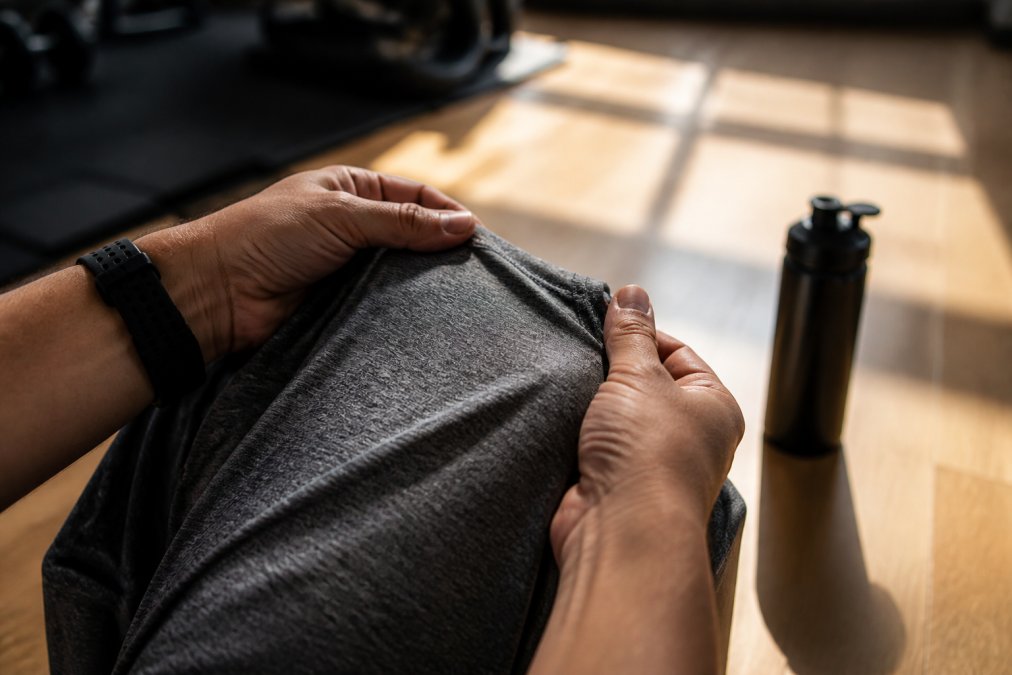
Moisture-wicking fabric moves sweat away from the skin so it evaporates quickly, and breathability lets heat escape instead of trapping it. Together they prevent the clammy, overheated feeling that hijacks attention mid-workout. Wicking depends on capillary action through the fiber and knit structure, so a thin, open knit moves vapor faster than a thick, tightly woven one, even when both carry the same "moisture-wicking" claim.
What to actually look for:
- Fiber blends over single fibers. Polyester and nylon dry fast but can feel slick; 5-15% spandex adds stretch without blocking airflow. Merino wool regulates temperature well but dries slowly and costs more, a trade-off, not a flaw.
- Knit structure, not coatings. A brushed or coated interior feels soft at first but traps heat and degrades with washing. An open, mesh-paneled knit breathes for the garment's life.
- Interior hand-feel. Run the inside of the fabric across the back of your wrist. If it catches, pills, or feels plasticky, that sensation will repeat thousands of times against your skin.
- Dry time. A quality wicking tee hung in still air should feel dry within roughly 30-60 minutes after a hard workout. If it is still damp after an hour, it will stay damp against you.
Fit, Range of Motion, and Distraction Management
Distraction management starts with fit. A garment should stay in place through a full range of motion without compressing or shifting. Test before you commit: raise both arms overhead, squat, and rotate your torso. If anything rides up, twists, or bunches, it will do the same at minute forty when your focus is thinnest.
Three fit variables do most of the work:
- Seam placement. Flatlock seams lie flat and reduce friction at the shoulders, underarms, and inner thigh, the three highest-chafe zones. Overlock (serged) seams are bulkier and rub more.
- Gusseted construction. A gusset is an extra panel at the crotch or underarm that adds range of motion without bulk, a clear signal of a garment designed for movement, not appearance.
- Hem and waistband stability. A silicone gripper or elastic band that stays put means no tugging mid-rep. Every adjustment is a small break in attention.
| Gear Quality | What It Supports | What to Check |
|---|---|---|
| Moisture-wicking fabric | Body awareness, comfort | Interior feel, dry time |
| Flatlock seams | Emotional regulation | Seam smoothness at friction points |
| Gusseted panels | Range of motion | Overhead and squat test |
| Four-way stretch | Range of motion | Overhead and squat test |
| Consistent sizing | Distraction management | Fit across repeat purchases |
Sensory-Friendly Construction: The Angle Most Gear Guides Skip
Most performance-gear content treats comfort as a nice-to-have. For a mindful athlete, comfort is the mechanism. The nervous system constantly scans for irritation, a tag, a rough seam, a waistband that digs, and each signal competes with the present-moment attention flow depends on.
Sensory-friendly construction means:
- Tagless labeling or printed care info instead of sewn-in tags at the neck.
- Soft-touch, low-pill fabrics that do not scratch or shed fibers onto the skin.
- Consistent fit across repeat purchases, so your body does not have to re-learn a garment every time you reorder.
- Minimal hardware, no exposed zippers, snaps, or drawcord tips in contact zones.
Tech-Free vs. Tech-Enabled: A Question Worth Asking
Wearables, heart-rate straps, HRV rings, GPS watches, can support mindful training with objective feedback on recovery and effort, or undermine it: athletes who track heavily let the numbers become the focus while internal cues (breath, tension, pace feel) get quieter. The mindful move is to decide deliberately, use the device for a specific purpose, then take it off for sessions where you train attention itself.
Mindful Gear Maintenance as a Practice
Caring for gear can be a ritual rather than a chore. Washing technical fabrics in cold water and air-drying them preserves the wicking structure and extends garment life. Tending to your equipment, folding it, checking seams, replacing worn items, builds a repeatable moment of gratitude and intentionality.
Sustainable Athletic Apparel: The Intersection of Ethics and Performance
Sustainable athletic apparel is gear made with materials and processes chosen to reduce environmental impact, and it has moved past the trade-off era. Athletes no longer have to accept lower performance to buy responsibly. Durable construction and responsible sourcing travel together, because both require makers to think past the next season.
What Actually Makes Athletic Apparel More Sustainable
- Recycled synthetics. Recycled polyester (rPET) performs nearly identically to virgin polyester in wicking and durability, and diverts plastic from landfills, one of the clearest wins in performance apparel.
- Lower-impact natural fibers. Merino wool is renewable, biodegradable, temperature-regulating, and odor-resistant, but costs more and dries more slowly than synthetics. Tencel (lyocell) is soft, breathable, and made in a closed-loop process that recaptures most of the solvent used.
- Durable construction. Reinforced stitching, gusseted panels, and quality zippers extend a garment's life. A shirt that lasts three years instead of one is more sustainable by definition.
- Check certification scope. OEKO-TEX STANDARD 100 tests certified textiles for harmful substances against its criteria. It does not certify reduced environmental impact or fair labor. Other schemes address different requirements; verify the exact label and certificate.
- Repairability. Brands that offer repair services or sell replacement parts (drawcords, zipper pulls) make it easier to keep gear in use rather than replace it.
The Mindful Angle: Fewer, Better, More Intentional
The most sustainable piece of gear is the one you already own and actually wear. Mindful athletes build smaller kits, a few pieces that fit well, perform reliably, and match how they train, rather than a closet of impulse buys. That reduces waste and decision fatigue while deepening the relationship between athlete and equipment.
A Note on Greenwashing
Not every "eco" claim on a hangtag is verifiable. Watch for vague language like "earth-friendly" or "natural" without a certification, and be skeptical of one sustainable feature marketing an otherwise disposable product. The most reliable signals are third-party certifications, published material composition, and a brand's willingness to discuss durability and repair.
How to Build a Mindful Training Routine with Your Gear
A mindful training routine treats gear, breath, and recovery as one system rather than three separate habits. The sequence below adds about ten minutes per session and compounds over weeks.
Step 1: Choose Gear That Matches Your Intentions
Decide what the session is for before you dress for it. A recovery day calls for soft, loose, breathable layers; a high-intensity session calls for compression where you need support and stretch where you need range. When clothing matches the workout's intent, you stop negotiating with your body mid-session.
Step 2: Integrate Breathwork and Body Scans Before Training
Spend three minutes before you start. Inhale through the nose for four counts, exhale for six, and scan from feet to head, noticing where you hold tension. This is body awareness in practice and doubles as a warm-up for attention; athletes who do it consistently report better focus in the first working sets.
Step 3: Use Post-Workout Recovery Protocols to Reinforce Mental Resilience
Recovery protocols are the structured habits after training that let the body adapt: cooling down, hydrating, changing out of damp gear, and reflecting briefly on what went well. A two-minute note on one thing you did well and one thing to adjust turns every session into feedback rather than judgment.
Conclusion: Gear That Supports Your Body and Your Values
The hard part of mindful training is not learning to breathe or buying the right shirt. It is sustaining the routine when motivation dips and the gym feels like an obligation. Gear that performs reliably removes one more excuse, and gear with a purpose gives you a reason beyond the workout itself.
Frequently Asked Questions
What features should mindful athletes look for in performance apparel?
Look for moisture-wicking, breathable fabrics that regulate temperature and reduce distractions. Flat seams and tagless labels prevent chafing during long sessions. A fit that allows full range of motion without being overly tight supports body awareness. Sustainable materials like recycled polyester or organic cotton align with values of environmental responsibility. Finally, consider gear that transitions from gym to daily wear, reinforcing a consistent mindful practice.
How does mindfulness improve athletic performance?
Mindfulness training enhances cognitive focus, emotional regulation, and body awareness. Athletes who practice mindful breathing and body scans report lower performance anxiety and faster recovery from mistakes. By staying present, you can respond to changing conditions instead of reacting on autopilot, which leads to better decision-making under pressure.
What is the connection between purpose-driven gear and athletic resilience?
Choosing a brand whose values matter to you can be a personal preference. Burrow Athletic states that every purchase supports The Be Good Foundation. That commitment is separate from any claim that clothing improves emotional regulation, reduces stress, or increases adherence to training.
How can clothing choices impact your focus during training?
Ill-fitting or uncomfortable clothing creates constant physical distractions, pulling your attention away from breath and movement. Moisture-wicking fabrics prevent dampness that can lead to chills or chafing. Seamless construction and soft materials reduce sensory irritation. When your gear feels invisible, you can direct full attention to your body's signals, heart rate, and technique. This sensory focus is a core component of mindful movement and supports a flow state.
How to integrate mindfulness into your daily workout routine?
Start with a two-minute breathing exercise before you put on your gear, setting an intention for the session. During warm-up, do a body scan from head to toe. As you train, anchor your attention on the sensation of your breath and the feel of your clothing against your skin. After your workout, take three deep breaths and note one thing you're grateful for. Use a journal or app to track how your mental clarity changes over time.
What are some effective mindfulness techniques for athletes?
Try box breathing (inhale 4 counts, hold 4, exhale 4, hold 4) to calm pre-competition nerves. Body scan meditation before bed improves recovery. Mindful walking during rest days builds body awareness. The 5 R's of mindfulness (recognize, release, return, repeat, rest) can be applied during training to reset after a mistake. Pair these techniques with performance gear that feels comfortable and aligns with your values to reinforce the mind-body connection.