

Last Updated: November 1, 2026
Quick Summary
Synthetic dyes are petroleum-derived colorants engineered to bond tightly to textile fibers, and their best-documented impact is environmental: dyeing consumes large volumes of water and energy and produces dye-heavy wastewater that can disrupt aquatic life. For wearers, the main documented concern is skin sensitization from disperse dyes in synthetic fabrics, worsened by sweat and friction.
- Dyeing's serious pollution happens upstream at the dyehouse, not in your washing machine.
- Polyester is almost always dyed with disperse dyes applied at high temperature and pressure.
- Skin irritation from residual disperse dye is a sensitization issue, not a cancer issue.
- Wash new dyed pieces separately the first time and expect some initial dye release.
- Wash cold on a short, gentle cycle and skip fabric softener to limit dye release.
Table of Contents
- Why Synthetic Dyes in Athletic Apparel Deserve a Closer Look
- The Environmental Impact of Textile Dyeing
- Health Questions: Azo Dyes, Heavy Metals and Skin Exposure
- Activewear and Sensitive Skin: What Sweat and Friction Change
- Natural Dyes vs Synthetic Dyes: An Honest Comparison
- How to Wash Activewear to Limit Dye Release
- What to Check Before You Buy Dyed Athletic Gear
- Building a Wardrobe That Matches Your Values
- Frequently Asked Questions
Why Synthetic Dyes in Athletic Apparel Deserve a Closer Look
Synthetic dyes are colorants made from petroleum-derived compounds, engineered to bond tightly to textile fibers and resist fading through sweat, sun and repeated washing. They dominate athletic apparel because they deliver vivid, colorfast results at low cost.
What you put on your body should support you, not work against you.
The short version: synthetic dyes are not automatically dangerous, but the category is broad, the testing is uneven, and the way you wash and wear dyed gear genuinely changes your exposure.
The Environmental Impact of Textile Dyeing
Textile dyeing is one of the most resource-intensive steps in apparel manufacturing, and its environmental footprint is the best-documented concern in the entire dye conversation. Dyeing and finishing consume large volumes of water and energy, and the process generates wastewater loaded with colorants, salts and chemical auxiliaries.
That is why environmental impact, not health risk, is where the strongest evidence sits. Color is hard to remove from water, and conventional treatment plants are not built to strip every dye compound before discharge.
Wastewater, Rivers and Aquatic Life
Wastewater is the core of the problem. Dye-heavy effluent is often hot, highly colored and saline, and when it reaches rivers and oceans it reduces light penetration and can disrupt aquatic life. Many dye compounds and their breakdown products persist in water rather than breaking down quickly.
A common mistake in reading about this is treating "dyed fabric" and "dye effluent" as the same risk. They aren't. The serious pollution happens upstream at the dyehouse, not in your washing machine. Still, the U.S. Environmental Protection Agency's water pollution resources are a useful starting point for understanding how industrial discharge is regulated and why color and chemical load matter.
Water, Energy and Emissions in the Dyeing Process
Dyeing is heat-intensive. Fixing dye to synthetic fibers typically requires sustained high temperatures, which drives both energy use and greenhouse gas emissions tied to textile manufacturing. Water use compounds it: large volumes are needed for dye baths and rinsing.
The practical takeaway for a shopper is that the environmental cost of a garment's color is front-loaded at production. Buying fewer, longer-lasting pieces and washing them less aggressively does more for the planet than agonizing over a single label claim.
Health Questions: Azo Dyes, Heavy Metals and Skin Exposure
Some synthetic dyes, particularly certain azo dyes, have raised health questions that are worth understanding. This is a real area of study, and it deserves honest treatment rather than alarmism.
Here's what most guides get wrong: they collapse "a dye chemical exists" into "your shirt is dangerous." Evidence quality matters. Exposure depends on whether a restricted substance is present, at what concentration, and whether it can migrate from fabric to skin. Regulators maintain restricted substance lists for textiles, and reputable brands test against them.
Which Dye Classes Are Used on Athletic Fabrics
Athletic apparel is mostly polyester, nylon and elastane blends, and those fibers demand different dye chemistry than cotton. Polyester is almost always dyed with disperse dyes, which are applied at high temperature and pressure because the dye must diffuse into the fiber rather than sit on the surface. Nylon takes acid dyes, which bond to the fiber's amine groups and generally hold up well to sweat and washing. Elastane is often dyed alongside polyester or nylon and can be the weak point for colorfastness because it stretches and recovers repeatedly.
The practical implication is that rinsing and finishing matter as much as the dye class on the label.
Exposure Pathways: Skin, Inhalation and Environment
Skin contact is the pathway most relevant to athletic apparel, but it is also the least direct. A dye molecule locked into a polyester fiber is not freely available to your skin; migration depends on sweat, heat, friction and the dye's chemical structure.
Inhalation is a minor pathway for finished apparel but matters upstream at the dyehouse, where workers handle powders and dye baths. Environmental exposure through wastewater is the best-documented pathway and the one with the clearest evidence base, as covered in the environmental section above.
What the Evidence Actually Supports
The category is not uniform, and skin irritation from residual disperse dye is a sensitization issue rather than a cancer issue; the two should not be conflated.
If you want to understand the regulatory baseline, the U.S. Consumer Product Safety Commission oversees consumer product safety in this market, and textile chemical restrictions are also tracked by standards bodies. The practical takeaway is to favor brands that test against restricted-substance lists and disclose results, and to treat cheap, untested goods as carrying more uncertainty rather than assuming all dyed gear is equally risky.
Activewear and Sensitive Skin: What Sweat and Friction Change
Activewear is worn in a different way from a cotton t-shirt. Synthetic fabrics like polyester and nylon are worn tight, trap heat, and get soaked in sweat while rubbing against skin for extended periods. That combination, heat plus moisture plus friction, is exactly what can increase the chance of skin irritation and make chemical residues more likely to interact with your skin.
But the mechanism deserves a closer look than most guides give it.
What the Evidence Shows and What It Doesn't
The demonstrated finding is that some people develop contact dermatitis from disperse dyes in synthetic clothing, and that sweating and friction worsen the reaction. What is not demonstrated is that compliant, well-rinsed athletic apparel transfers enough dye to cause systemic harm. The distinction matters: sensitization is a real and documented skin response, while claims that sweat pulls carcinogens out of your leggings are not supported by the evidence.
Practical Steps for Sensitive Skin
If you have sensitive skin, the fabric matters as much as the dye. Moisture-wicking synthetics can reduce chafing when they fit well, but poorly finished seams and residual dye or finishing chemicals are common culprits behind contact irritation.
- Watch for itching or redness concentrated at seams and waistbands, where friction is highest
- Wash new dyed gear before first wear
- Choose fabrics that feel comfortable against your skin if you react easily
- Rotate moisture-wicking pieces so damp fabric isn't sitting against skin for hours
- Try a new piece during a short workout before committing to a long training session
Natural Dyes vs Synthetic Dyes: An Honest Comparison
Natural dyes come from plants, minerals and insects; synthetic dyes are manufactured from petrochemical sources. The honest comparison is not "natural good, synthetic bad." Each has real trade-offs, and athletic performance tilts the decision.
Natural dyes and synthetic dyes each involve trade-offs, and athletic performance often tilts the decision toward synthetic dyes for colorfastness and cost. For a closer look at why sustainable activewear costs more, that trade-off is worth understanding before you buy.
| Factor | Natural Dyes | Synthetic Dyes |
|---|---|---|
| Colorfastness on synthetics | Weak, fades with sweat and washing | Strong, engineered to hold |
| Environmental load | Lower chemical toxicity | Higher wastewater and energy load |
| Cost | Higher, often inconsistent | Lower, highly consistent |
| Best for | Low-impact, natural-fiber pieces | High-performance activewear |
How to Wash Activewear to Limit Dye Release
Washing is where dye transfer and fading happen at home, and a few habits meaningfully reduce both dye release and your exposure to it. The goal is gentle, cool and infrequent.
- Turn garments inside out. This reduces surface abrasion and dye loss on the outside of the fabric.
- Wash cold. Heat opens dye bonds and accelerates fading; cold water is gentler on color and fabric.
- Use a short, gentle cycle. Less agitation means less dye transfer between garments.
- Wash like colors together. Sort darks and brights so loose dye has nowhere to bleed onto.
- Skip fabric softener. It coats technical fibers and can trap residue; use a sport-specific detergent instead.
- Air dry when possible. High dryer heat stresses both dye and elastic fibers.
- Wash new dyed pieces separately the first time. Expect some initial dye release and keep it away from light colors.
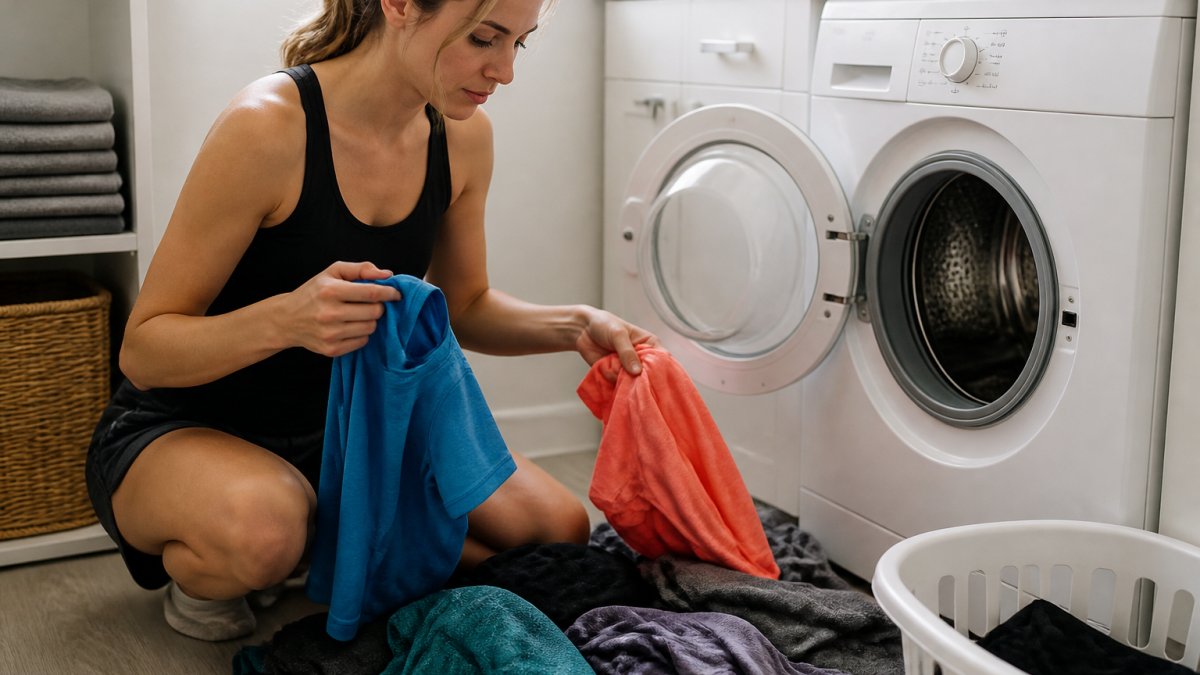
For a fuller step-by-step routine, see our guide on how to wash athletic performance gear.
What to Check Before You Buy Dyed Athletic Gear
The label is your best evidence, and most shoppers don't read it closely enough. Look for restricted-substance compliance, fiber content, and whether the brand explains its dyeing process at all. Vague "eco-friendly" language means little; specifics mean a lot.
- Does the brand name its dye approach or testing standard?
- Is fiber content clear, and does it suit your activity?
- Are care instructions specific about cold washing and dye bleed?
- Does the brand disclose where and how dyeing happens?
- Are there third-party certifications, or only marketing claims?
Our guide to choosing ethical workout gear turns these checks into a practical shopping checklist.
Building a Wardrobe That Matches Your Values
The most sustainable dyed athletic apparel is the gear you actually wear for years. If you want to align your wardrobe with your values, see our guidance on how to find sustainable gym clothes that perform. Readers drawn to that approach can learn about the benefits of mission driven activewear brands.
That's the standard we hold ourselves to at Burrow Athletic. Our GOAT headwear is the product line currently on sale, and every purchase supports The Be Good Foundation, our commitment to compassion and community.
You can also explore the Be Good Foundation to see where that support goes.
Frequently Asked Questions
What are synthetic dyes used for in athletic apparel?
Synthetic dyes give polyester, nylon and other synthetic fabrics their color and are chosen because they bond tightly to manufactured fibers. That bond matters for activewear: it holds color through sweat, stretching and repeated washing, which is why bright, colorfast gym clothes are usually dyed synthetically. The tradeoff is that dyeing synthetic fabric typically needs more heat and energy than dyeing cotton, and some dye chemistries raise environmental and skin-sensitivity questions worth checking before you buy.
Can dyes in activewear irritate sensitive skin?
They can for some people. Some people report skin irritation from synthetic activewear, and reactions can vary from person to person. If your skin reacts, try a few practical steps: wash new activewear before wearing it, choose lighter colors where dye loads are lower, rinse thoroughly after training, and switch to a looser fit for high-sweat sessions. Persistent rashes deserve a dermatologist's look rather than a guess about fabric.
Does washing synthetic athletic clothing release dye or microfibers?
Yes, both happen over time. Some unfixed dye rinses out in the first few washes, and synthetic fabrics shed small fibers with every cycle. You can slow this down: wash cold, turn garments inside out, use a gentle cycle, skip harsh detergents and bleach, and avoid over-washing gear that only needs airing out. A microfiber-catching laundry bag also reduces what reaches wastewater. Line drying instead of high heat keeps color fastness intact longer.
Are natural dyes more sustainable than synthetic dyes?
Not automatically. Natural and synthetic dyes each involve trade-offs in color consistency and colorfastness, and the way a dyehouse manages its wastewater affects the environmental outcome. Judge a brand by how it manages its dyeing process, not by the natural-versus-synthetic label alone.
The dye conversation is complicated, and most of it happens far from the gym. What you control is what you buy, how you wash it, and how long you keep it in rotation. We'd rather you train in gear you trust than chase labels that promise more than they prove. Explore the GOAT headwear collection at Burrow Athletic and wear something that stands for character, resilience and giving back.
